

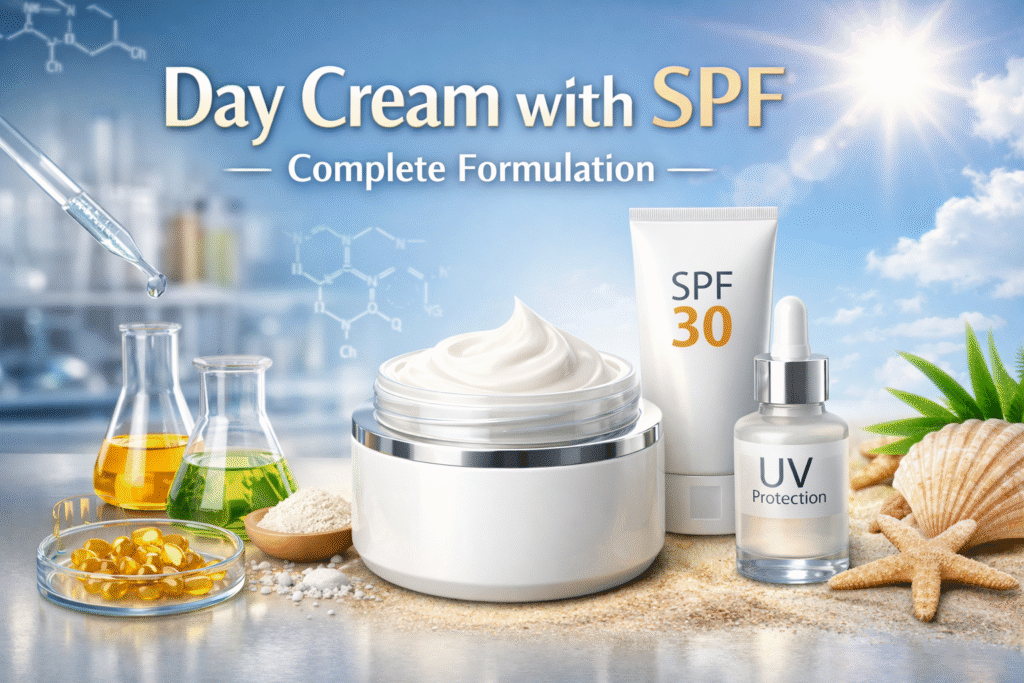
Day Cream with SPF (Broad Spectrum Protection)
Discover the complete commercial formulation of Day Cream with SPF, designed for daily sun protection and skin hydration. This in-depth guide covers ingredients, percentages, functions, manufacturing SOP, and formulation science behind a high-performance SPF day cream. Ideal for cosmetic brands, formulators, and private label skincare businesses looking to develop a broad-spectrum, lightweight, and effective daytime moisturizer with SPF.
Table of Contents
Product Description
This Day Cream with SPF is a lightweight yet deeply nourishing daily moisturizer designed to protect the skin from harmful UVA & UVB rays, environmental stressors, and premature aging. Enriched with broad-spectrum UV filters, hydrating agents, antioxidants, and skin-soothing ingredients, it provides long-lasting moisture, non-greasy feel, and a smooth, radiant complexion. Suitable for daily use under makeup and for all skin types.
Uses
- Daily sun protection
- Prevents sunburn & photoaging
- Moisturizes and softens skin
- Protects against environmental damage
- Ideal as a daytime moisturizer & makeup base
Key Benefits
- Broad-spectrum SPF protection
- Lightweight, fast-absorbing texture
- Non-sticky & non-comedogenic
- Hydrates and strengthens skin barrier
- Helps reduce signs of premature aging
- Suitable for normal, dry & combination skin
🧴 Commercial Day Cream with SPF – Complete Formulation
Batch Size: 1000 g (1 kg)
(Percentages can be scaled easily)
Phase A – Water Phase
| Ingredient | % | Weight (g) | Function |
|---|---|---|---|
| Deionized Water | 55.50 | 555 | Base solvent |
| Glycerin | 4.00 | 40 | Humectant, hydration |
| Propanediol | 3.00 | 30 | Humectant, penetration enhancer |
| Disodium EDTA | 0.10 | 1 | Chelating agent |
| Xanthan Gum | 0.30 | 3 | Viscosity & stabilization |
Phase B – Oil Phase (SPF & Emulsifiers)
| Ingredient | % | Weight (g) | Function |
|---|---|---|---|
| Caprylic/Capric Triglyceride | 6.00 | 60 | Lightweight emollient |
| Cetyl Alcohol | 2.00 | 20 | Texture & stability |
| Glyceryl Stearate & PEG-100 Stearate | 3.00 | 30 | Emulsifier |
| Cetearyl Alcohol | 2.00 | 20 | Thickener, co-emulsifier |
| Ethylhexyl Methoxycinnamate | 7.50 | 75 | UVB filter |
| Butyl Methoxydibenzoylmethane | 3.00 | 30 | UVA filter |
| Octocrylene | 3.00 | 30 | UV stabilizer & UVB filter |
| Tocopheryl Acetate (Vitamin E) | 0.50 | 5 | Antioxidant |
Phase C – Cool Down Phase (Actives)
| Ingredient | % | Weight (g) | Function |
|---|---|---|---|
| Panthenol (Vitamin B5) | 1.00 | 10 | Soothing & moisturizing |
| Aloe Vera Extract (1:10) | 2.00 | 20 | Calming & hydration |
| Allantoin | 0.30 | 3 | Skin repair |
| Phenoxyethanol & Ethylhexylglycerin | 1.00 | 10 | Preservative |
| Fragrance (IFRA compliant) | 0.30 | 3 | Sensory appeal |
| Triethanolamine / NaOH | q.s. | — | pH adjustment (5.5–6.0) |
Total: 100% = 1000 g
🏭 Manufacturing SOP (Standard Operating Procedure)
Step 1: Preparation
- Clean and sanitize all equipment
- Wear gloves, mask, hairnet
- Ensure calibrated weighing scale
- Maintain GMP standards
Step 2: Water Phase (Phase A)
- Add Deionized Water into main vessel
- Start slow mixing (500–700 RPM)
- Add Disodium EDTA → dissolve completely
- Add Glycerin & Propanediol
- Pre-disperse Xanthan Gum in glycerin and add slowly
- Heat Phase A to 75°C ±2°C
Step 3: Oil Phase (Phase B)
- In a separate vessel, add all oil phase ingredients
- Add UV filters and emulsifiers
- Heat to 75°C ±2°C until fully melted and uniform
Step 4: Emulsification
- Slowly add Phase B into Phase A
- Homogenize at 3000–4000 RPM for 3–5 minutes
- Maintain temperature at ~75°C during emulsification
Step 5: Cooling Phase
- Reduce mixing speed to 800–1000 RPM
- Cool batch gradually to 40°C
Step 6: Add Cool-Down Ingredients (Phase C)
- Add Panthenol, Aloe Vera, Allantoin
- Add Preservative system
- Add fragrance (optional)
- Adjust pH to 5.5 – 6.0
Step 7: Final Homogenization
- Mix for 10–15 minutes
- Ensure smooth, lump-free cream
Step 8: Quality Control
- pH check
- Viscosity test
- Appearance & odor check
- Stability testing (heat/cold cycles)
Step 9: Filling & Packaging
- Fill into airless pumps or UV-protective tubes
- Store below 30°C
⚠️ Important Notes
- SPF value must be lab tested (in-vivo/in-vitro) before marketing
- Follow local cosmetic regulatory guidelines
- Use UV filters within legal limits of your country
Related posts:
 Gentle Daily Face Cleanser – High-Quality Formulation
 Vitamin C Face Wash – Complete Product Formulation
 Rose Water Toner – Complete Formulation Guide
 Niacinamide Toner – Commercial Formulation Step by Step Guide
 Vitamin C Brightening Serum Complete Formulation | Stable SAP Vitamin C Guide
 Hyaluronic Acid – The Ultimate Guide to Deep Hydration and Youthful Skin