
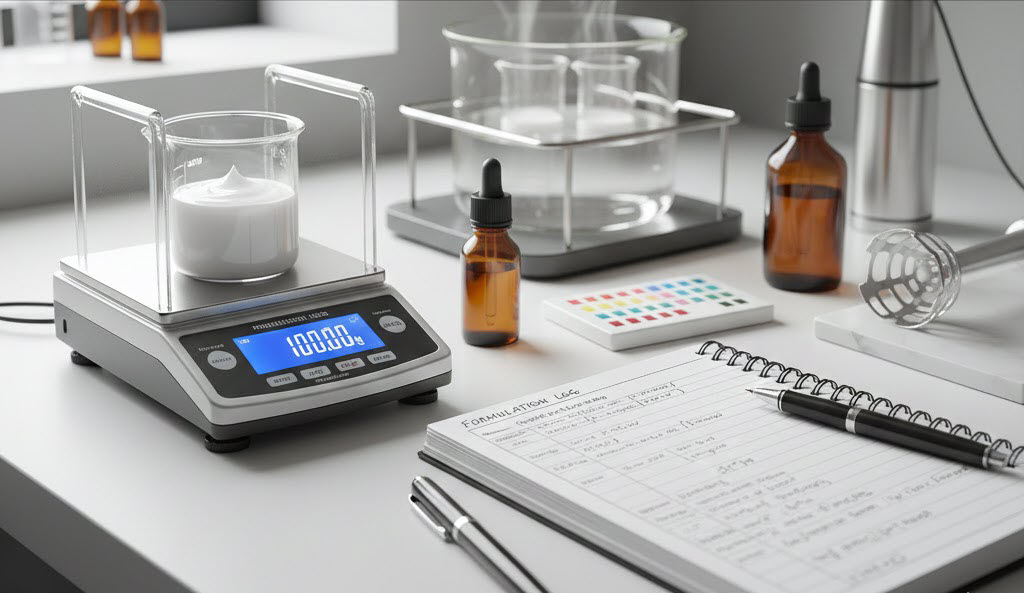
2. Cosmetic Formulation Knowledge (Required)
This is specific knowledge about:
- How to calculate % (percentages)
- How to scale formulas (like 1 kg, 100 kg batches)
- How ingredients behave
- What ingredients cannot be mixed
- Heating & cooling phases
- Correct mixing speeds
- Using emulsifiers & thickeners
- Working with preservatives
- Understanding allergens & irritants
Most formulators learn this through:
✔ Online cosmetic formulation courses
✔ Cosmetic science diplomas
✔ Practical lab training
Great — below is a deep, practical explainer of Cosmetic Formulation Knowledge with worked examples at every step. I’ll use the same simple 100 g O/W cream formula from earlier so you can see each concept applied, then show how to scale, what to watch for, and hands-on tests you can run in a beginner lab.
1 — How to calculate % (percentages) — step-by-step (digit-by-digit math)
Reference formula (percent % by weight):
- Water — 70%
- Oils — 20%
- Emulsifier — 6%
- Glycerin (humectant) — 3%
- Preservative & actives — 1%
Total = 100%
Convert to grams for a 100 g batch (step by step)
Formula: grams = (percent ÷ 100) × total batch weight
- Water: (70 ÷ 100) × 100 g = 0.70 × 100 g = 70 g.
- Oils: (20 ÷ 100) × 100 g = 0.20 × 100 g = 20 g.
- Emulsifier: (6 ÷ 100) × 100 g = 0.06 × 100 g = 6 g.
- Glycerin: (3 ÷ 100) × 100 g = 0.03 × 100 g = 3 g.
- Preservative: (1 ÷ 100) × 100 g = 0.01 × 100 g = 1 g.
Check: 70 + 20 + 6 + 3 + 1 = 100 g.
Scale to 1 kg (1,000 g) — exact arithmetic
- Water: (70 ÷ 100) × 1,000 g = 0.70 × 1,000 g = 700 g.
- Oils: 0.20 × 1,000 g = 200 g.
- Emulsifier: 0.06 × 1,000 g = 60 g.
- Glycerin: 0.03 × 1,000 g = 30 g.
- Preservative: 0.01 × 1,000 g = 10 g.
Check: 700 + 200 + 60 + 30 + 10 = 1,000 g.
Scale to 100 kg (100,000 g) — exact arithmetic
- Water: 0.70 × 100,000 g = 70,000 g (which is 70 kg).
- Oils: 0.20 × 100,000 g = 20,000 g (20 kg).
- Emulsifier: 0.06 × 100,000 g = 6,000 g (6 kg).
- Glycerin: 0.03 × 100,000 g = 3,000 g (3 kg).
- Preservative: 0.01 × 100,000 g = 1,000 g (1 kg).
Check: 70,000 + 20,000 + 6,000 + 3,000 + 1,000 = 100,000 g (100 kg).
Practical tip: Always do percent → grams with exact arithmetic and then round to the smallest scale that your balance supports (e.g., to 0.01 g for small batches, to 1 g for large batches). Keep the rounding in your batch record.
2 — How to scale formulas (practical notes & pitfalls)
Direct proportional scaling works when you keep percentages identical. But watch for:
- Non-linear ingredients: some components (preservatives, fragrances, actives) may be used at fixed ppm/percent limits or need to be scaled with extra care.
- Mixing & heat transfer: larger batches need longer heating times, different mixing power, and different cooling profiles.
- Equipment limitations: small homogenizers don’t scale linearly — in industry you may need different rotor-stator sizes or valve homogenizers.
- Ingredient batching: suppliers sometimes ship ingredients in large lots — check minimum order sizes and batch traceability.
Practical example: For a 100 g batch you might homogenize 2–3 minutes at high shear. For a 100 kg batch you’ll need a high-shear in-line homogenizer and likely longer mixing times and different rpm to achieve similar droplet sizes.
3 — How ingredients behave (categories + practical examples)
Understanding functional classes helps place ingredients in phases and predict behavior.
Common functional categories (with examples & behavior)
- Solvents / carriers — water, propanediol → dissolve water-soluble actives.
Practical: hyaluronic acid (HA) powder must be dispersed into water and hydrated slowly (may take hours). - Humectants — glycerin, propylene glycol → hold water, improve skin feel, may increase tackiness at high levels.
Practical: glycerin at 20% will be sticky; use 2–5% in creams to avoid tack. - Emollients / oils — jojoba, squalane, shea butter → lubricate, change skin feel (silky, heavy).
Practical: heavier butters like shea increase viscosity and give occlusion. - Occlusives — petrolatum, dimethicone → prevent water loss; feel heavier.
- Actives — niacinamide, vitamin C, retinol → targeted efficacy, often sensitive to pH/light/oxygen.
- Surfactants / emulsifiers — decyl glucoside, polysorbates, cetearyl alcohol → enable mixing of oil+water; HLB matters.
- Thickeners / rheology modifiers — xanthan gum, carbomer, HEC, stearic acid → change viscosity & sensory.
- Preservatives — phenoxyethanol, benzyl alcohol + dehydroacetic acid → protect against microbes; pH dependent.
- Antioxidants / chelators — tocopherol, EDTA → protect oils from oxidation.
- Fragrances / essential oils — sensory; common allergens and oxidation vulnerable.
Practical examples (behavior):
- Glycerin dissolves instantly in water — put in water phase.
- Vitamin E (tocopherol) dissolves in oil — add with oil phase.
- Hyaluronic acid: add to cool water or prehydrate; adding directly to hot water can create lumps.
4 — What ingredients cannot be mixed (common incompatibilities)
Important incompatibilities you’ll see repeatedly:
- Vitamin C (L-ascorbic acid) + Niacinamide
- They can react under high temperature and low pH to form nicotinic acid (irritant) — but in modern formulations at correct pH and temps they often coexist.
- Practical rule: Add separately (one in water phase, one in cool-down) or use stable derivatives (ascorbyl tetraisopalmitate, sodium ascorbyl phosphate) if you want both.
- Retinol + Acids / Benzoyl Peroxide
- Retinol is unstable in acidic environments and is oxidized by benzoyl peroxide. Avoid combining in the same product.
- Acids (AHA/BHA) + Certain Preservatives
- Some preservatives lose efficacy at low pH (e.g., parabens are fine, but some organic acids only work at low pH). Always check supplier guidance.
- High electrolyte (salt) levels + some nonionic surfactants
- Sodium chloride can thicken or break some surfactant systems. Example: adding salt to decyl glucoside systems changes viscosity — test small batches.
- Proteins/enzymes + preservatives/heat
- Proteins (collagen, enzymes) denature at high heat — add in cool down and choose compatible preservatives.
- Metal ions + actives
- Metals can catalyze oxidation (e.g., iron). Use chelators (EDTA) to bind trace metals.
Practical experiment: make two 30 g samples — sample A: niacinamide + L-ascorbic acid added together at 50 °C; sample B: add ascorbic acid to water phase and niacinamide in cool down at <40 °C. Compare clarity, color change after 48 hours. You’ll likely see browning in the hot mixed sample.
5 — Heating & cooling phases (why, temps, timings)
Why: many ingredients must be melted/homogenized or hydrated at controlled temperatures; heat affects solubility and emulsion formation and can degrade heat-sensitive actives.
Typical temperature guide (O/W cream):
- Heat both phases to 70–75 °C — this melts waxes/butters and ensures both phases are same temperature for stable emulsification.
- Mix/emulsify at ~70–75 °C while creating shear.
- Cool slowly to ~45 °C — add preservatives, fragrances (if heat-sensitive), and water-soluble actives.
- Cool to ≤40 °C — add vitamins like niacinamide; add peptides or enzymes at manufacturer’s recommended temps (often <30–35 °C).
- Ambient — package when viscosity is stable and below ~30–35 °C for best handling.
Timing example (100 g SOP):
- Heat phases: 10 min to reach temp.
- Emulsify: 2–5 min high shear.
- Cool with stirring: 15–30 min depending on batch and cooling method.
- Add cool down actives: at ≤45 °C.
Practical tip: Rapid cooling can trap unstable droplet structure; slow cooling with gentle agitation often yields better texture.
6 — Correct mixing speeds (practical RPM/tech guidance)
Mixing speed depends on equipment and batch size. I’ll give typical lab guidance — always follow equipment manufacturer specs.
- Low shear mixing / propeller: ~200–800 rpm — good for dissolving water phase humectants, gentle blending.
- Medium shear stirring: ~800–2,000 rpm — used when combining phases and when initial droplet breakup begins.
- High shear / rotor-stator homogenizer: ~3,000–10,000 rpm (or higher depending on device) — used to achieve fine oil droplet sizes for stable emulsions.
- Ultrasonic homogenizers: variable power, used for nano-emulsions and serums.
Practical example (100 g cream):
- Heat phases separately while mixing at 300–500 rpm.
- When pouring oil into water, start homogenizer at ~4,000 rpm for 2–3 minutes.
- Reduce to ~800 rpm while cooling and stirring gently to avoid entraining air.
Note on aeration: high shear creates foam/air. Degassing or vacuum can remove air if needed.
7 — Using emulsifiers & thickeners (HLB, usage levels, examples)
Emulsifiers — HLB concept in practice
- HLB (Hydrophilic-Lipophilic Balance) helps select emulsifiers for your oil mix.
- High HLB (8–18) → favors O/W emulsions.
- Low HLB (3–6) → favors W/O emulsions.
Common emulsifiers & ballpark usage
- Polawax (PEG-wax) — use 3–6% for creams (O/W).
- Olivem 1000 (natural PEG-free) — 3–6%, good skin feel.
- Glyceryl stearate + PEG-100 stearate blends — 2–10% depending on desired texture.
- Sorbitan esters (Span) / polysorbate mixes — combined to reach target HLB.
Practical example: For a 20 g oil phase composed of jojoba (10 g), almond oil (5 g), shea butter (5 g), compute required HLB and choose emulsifier or blend accordingly — many suppliers give HLB match tables; if using a preblend emulsifier (Olivem/Polawax) follow supplier use level 4–6%.
Thickeners / rheology modifiers
- Carbomer (Carbopol): typical 0.2–1.0% for gels; requires neutralization (NaOH or triethanolamine) to build viscosity. Add to water phase or prehydrate in glycerin then disperse.
- Xanthan gum: 0.1–0.6% in water; hydrate with high shear to avoid clumps.
- Hydroxyethylcellulose (HEC): 0.3–2%, used in surfactant systems for body/face wash viscosity.
- Stearic acid / cetearyl alcohol: acts as co-emulsifier and increases body (1–8%).
Practical hints:
- Some thickeners require neutralization (carbomer).
- Salt can thicken or destabilize certain thickeners — always test in small samples.
8 — Working with preservatives (selection & validation)
Key points:
- Always include a broad-spectrum preservative in water-containing products.
- Select based on: pH range, solubility (oil vs water soluble), compatibility with other ingredients, regional regulatory limits.
- Common systems: phenoxyethanol + ethylhexylglycerin (~0.5–1.0%), benzyl alcohol + dehydroacetic acid combinations, or paraben blends where permitted.
pH dependency examples:
- Phenoxyethanol is effective roughly pH 3–10 (supplier specific).
- Parabens work across broad pH but consumer avoidance may be a consideration.
- Organic acids (sorbic acid) are more effective at lower pH.
Validation:
- Microbial challenge testing (inoculate with bacteria/yeast/mold and measure log reduction) is the industry standard. Do this in an accredited lab before commercial release.
- Preservative efficacy is influenced by: formula composition, chelators, oil content, pH, and packaging.
Practical bench test (learning):
- Make small 30 g samples with 0.8% phenoxyethanol and one without preservative. Keep them open/handled for two weeks and visually inspect for microbial growth — the unpreserved one will likely show changes faster. Note: This is only a rough learning test — not a replacement for formal challenge testing.
9 — Understanding allergens & irritants (identify, avoid, test)
Common allergenic/irritant groups
- Fragrances & essential oils — linalool, limonene, cinnamal, eugenol — top allergen sources.
- Isothiazolinones (Methylisothiazolinone / MIT, CMIT) — strong allergens; restricted in many markets for leave-on products.
- Formaldehyde releasers — DMDM hydantoin, quaternium-15 — possible sensitizers.
- Paraffin/petrolatum — low allergenicity but some consumers avoid petroleum derivatives.
- Nut oils (almond) — allergen for people with tree nut allergy — must be labeled.
- Lanolin — can be allergenic.
- Sulfate surfactants (SLS/SLES) — can be irritating, especially on face.
Practical risk-management
- Label ALL INCI ingredients on packaging. Consumers rely on INCI names (e.g., Prunus amygdalus dulcis oil for almond oil).
- Minimize fragrance or offer fragrance-free variants for sensitive skin lines.
- Patch test: for new formulas, perform a 48-hour patch test on volunteers (small area) and record any reaction. Stop if irritation occurs.
- Claims caution: “Hypoallergenic” or “dermatologist tested” have regulatory / ethical implications — ensure proper testing before advertising.
10 — Practical experiments & tests you can run (mini-lab checklist)
- Percent → Gram practice: convert several formulas (100 g, 250 g, 1,000 g).
- Compatibility test: make two 30 g samples mixing actives in different phases and temperatures; observe clarity, color, and odor for 1 week.
- Freeze/thaw cycle: place sample at −5 °C for 24 h, then at 45 °C for 24 h; repeat 3 cycles and inspect for separation.
- pH drift test: measure pH at day 0, day 7, day 30.
- Oxidation test: oil + antioxidant vs oil alone at 60 °C (short accelerated test) — smell/colour change.
- Foam & irritation test for surfactants: prepare 1% surfactant solutions, foam test and optional small patch test.
- Patch testing: apply small amount of finished product on inner forearm under occlusion for 48 h — inspect for redness, itching.
11 — Documentation, SOPs, and batch records (must do)
Every batch — even experiments — should have:
- Batch number & date
- Exact weights (with unit precision)
- Supplier & lot numbers for raw materials
- Temperatures & times for heating/cooling phases
- Mixing speeds / equipment used
- pH measurement & adjustments made
- Observations (appearance, smell, viscosity)
- Stability test results and packaging used
Practical template: create a one-page batch record you fill each time; this becomes valuable when scaling and for troubleshooting.
12 — Quick troubleshooting (common failures & fixes)
- Cream separates → possible HLB mismatch, insufficient emulsifier, or temperature mismatch. Fix: remake with correct emulsifier % or gently re-emulsify with high shear and test again.
- Grainy texture → shea butter not fully melted or wax crystallization; remelt and homogenize.
- Sticky / tacky finish → humectant too high or wrong emollients; reduce glycerin or swap heavier oils for lighter esters.
- Off-odor → oxidation of oils; add antioxidant or change oil; improve packaging.
- pH drift → buffer with appropriate agents or adjust preservative choice.
13 — Final practical checklist before you go from prototype → pilot
- Run 3 small batches (repeatable formula) and compare.
- Conduct short stability (freeze/thaw + heat) and visual checks for 2–4 weeks.
- Do patch tests on volunteers.
- Verify preservative efficacy via third-party challenge test before commercialization.
- Prepare SOPs, labels (INCI list), and regulatory docs per local law.