

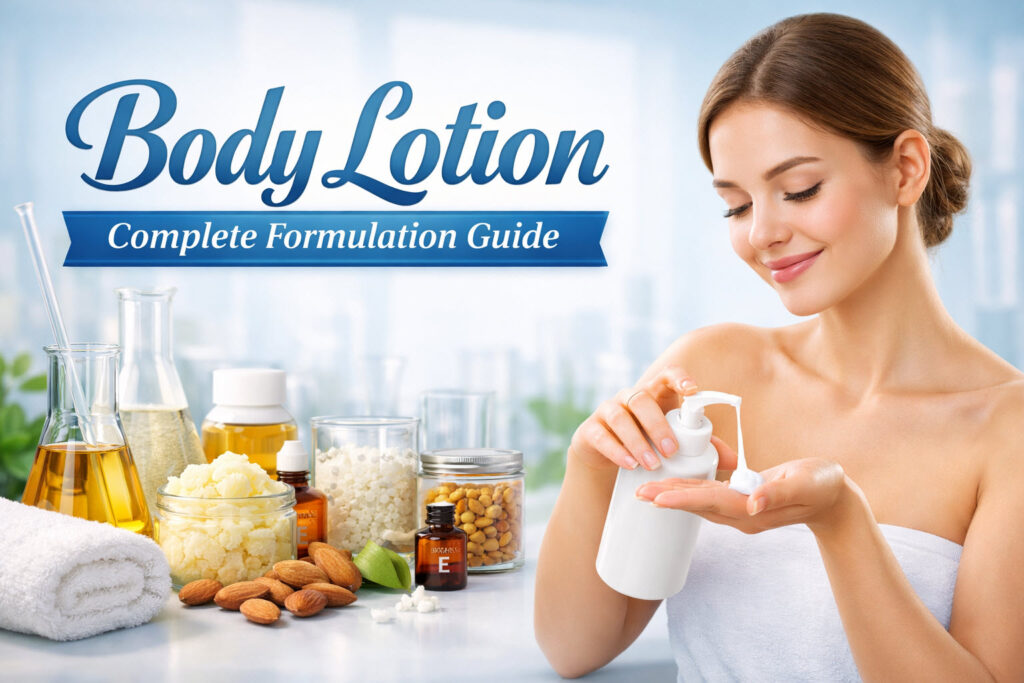
Body Lotion Formulation Complete Guide
Body lotion is an essential skincare product designed to provide deep hydration, long-lasting moisture, and skin nourishment for all skin types. This Body Lotion Complete Formulation Guide offers a comprehensive, professional breakdown of how body lotions are formulated, manufactured, and optimized for performance, stability, and skin compatibility.
In this guide, you will explore the scientific formulation of body lotion, including water phase and oil phase composition, emulsifiers, humectants, emollients, preservatives, and stabilizers. The formulation is suitable for commercial cosmetic manufacturing, private labeling, and startup skincare brands seeking high-quality, dermatologically balanced body lotion formulas.
The guide explains how body lotion works to repair the skin barrier, prevent transepidermal water loss (TEWL), and improve skin texture using ingredients such as glycerin, shea butter, almond oil, emulsifying wax, and vitamin E. Each ingredient is selected to ensure optimal moisturizing, softening, and protective benefits while maintaining a skin-friendly pH level.
This detailed formulation guide is ideal for:
- Cosmetic formulators
- Skincare brand owners
- Beauty entrepreneurs
- Private label manufacturers
- Students of cosmetic science
The manufacturing section covers step-by-step SOPs, including raw material handling, heating phases, emulsification, cooling, pH adjustment, homogenization, filling, and quality control checks. The process follows cosmetic GMP standards to ensure product safety, stability, and consistency.
Whether you are creating a moisturizing body lotion, whitening body lotion, herbal body lotion, or luxury skincare product, this guide provides a solid foundation for developing high-performance, market-ready body lotions suitable for all climates.
Table of Contents
Introduction
Body lotion is a topical cosmetic emulsion designed to hydrate, nourish, and protect the skin. It works by replenishing moisture, strengthening the skin barrier, and improving skin texture. Regular use helps maintain smooth, soft, and healthy-looking skin while preventing dryness and irritation caused by environmental stressors.
Uses of Body Lotion
| Use | Description |
|---|---|
| Daily Moisturization | Prevents dryness and water loss |
| Skin Softening | Improves rough and flaky skin |
| Barrier Repair | Strengthens the skin’s natural protective layer |
| After-Bath Care | Locks in moisture after cleansing |
| Seasonal Protection | Protects skin in dry or cold weather |
| Skin Comfort | Soothes irritated and sensitive skin |
Benefits of Body Lotion
| Benefit | Effect on Skin |
|---|---|
| Deep Hydration | Maintains long-lasting moisture |
| Smooth Texture | Makes skin soft and supple |
| Improved Elasticity | Enhances skin flexibility |
| Nourishment | Supplies essential lipids and humectants |
| Healthy Glow | Gives a fresh, well-cared appearance |
| Protection | Shields skin from environmental damage |
Body Lotion Formulation (1,000 g Batch)
Formulation Table
| Phase | Ingredient | Percentage (%) | Weight (g) | Function |
|---|---|---|---|---|
| A | Purified Water (Aqua) | 70.00 | 700 g | Main solvent, hydration base |
| A | Glycerin | 5.00 | 50 g | Humectant, moisture retention |
| A | Xanthan Gum | 0.30 | 3 g | Thickener, stabilizer |
| B | Sweet Almond Oil | 8.00 | 80 g | Emollient, skin softening |
| B | Shea Butter | 4.00 | 40 g | Deep nourishment, barrier repair |
| B | Cetyl Alcohol | 3.00 | 30 g | Thickener, texture enhancer |
| B | Emulsifying Wax (NF) | 5.00 | 50 g | Emulsifier (oil + water binding) |
| C | Vitamin E (Tocopherol) | 0.50 | 5 g | Antioxidant, skin protection |
| C | Phenoxyethanol & Ethylhexylglycerin | 1.00 | 10 g | Preservative |
| C | Fragrance | 0.50 | 5 g | Product scent |
| C | pH Adjuster (Citric Acid / NaOH) | q.s | q.s | pH adjustment (5.0–5.5) |
| Total | 100% | 1000 g |
Manufacturing SOP (Standard Operating Procedure)
1. Preparation & Safety
- Clean and sanitize all equipment, utensils, and containers.
- Wear PPE: gloves, mask, hair cover.
- Ensure raw materials are weighed accurately.
- Maintain a clean, dust-free environment.
2. Phase A – Water Phase
- Add Purified Water to the main stainless steel vessel.
- Slowly add Glycerin and mix until uniform.
- Pre-disperse Xanthan Gum in a small amount of glycerin or water.
- Add the gum mixture to Phase A with continuous stirring.
- Heat Phase A to 70–75°C.
3. Phase B – Oil Phase
- In a separate vessel, add:
- Sweet Almond Oil
- Shea Butter
- Cetyl Alcohol
- Emulsifying Wax
- Heat Phase B to 70–75°C until all solids are fully melted.
- Mix until a clear and uniform oil phase is obtained.
4. Emulsification
- When both phases reach the same temperature (70–75°C):
- Slowly add Phase B into Phase A.
- Mix using a homogenizer or high-speed stirrer for 3–5 minutes.
- Continue gentle stirring to form a stable emulsion.
5. Cooling Phase
- Begin cooling the emulsion gradually.
- Stir continuously while temperature drops to 40–45°C.
- This prevents separation and improves texture.
6. Phase C – Cool Down Additives
- At below 40°C, add:
- Vitamin E
- Preservative
- Fragrance
- Mix gently until fully incorporated.
7. pH Adjustment
- Measure pH using a calibrated pH meter.
- Adjust pH to 5.0 – 5.5 using:
- Citric Acid solution (to lower pH), or
- Sodium Hydroxide solution (to raise pH)
- Mix and recheck pH.
8. Final Homogenization
- Homogenize lightly for 1–2 minutes for smooth texture.
- Avoid excessive air incorporation.
9. Filling & Packaging
- Transfer the lotion into clean containers.
- Seal immediately to avoid contamination.
- Label with batch number, manufacturing date, and expiry.
10. Quality Control Checks
- Appearance: Smooth, uniform, no separation
- pH: 5.0 – 5.5
- Odor: Pleasant, no off-smell
- Stability: Observe for 24–48 hours
FAQs
1. What is body lotion used for?
Body lotion is used to hydrate, moisturize, and protect the skin by restoring moisture levels and strengthening the skin barrier. It helps prevent dryness, flaking, and rough texture.
2. What are the main ingredients in body lotion?
The main ingredients in body lotion include water, glycerin, emollient oils, butters, emulsifying wax, preservatives, and fragrance. These ingredients work together to hydrate, soften, and protect the skin.
3. How is body lotion formulated?
Body lotion is formulated by emulsifying an oil phase and a water phase at controlled temperatures, followed by cooling and adding heat-sensitive ingredients such as preservatives and fragrance.
4. What is the ideal pH of body lotion?
The ideal pH of body lotion is between 5.0 and 5.5, which matches the natural pH of human skin and helps prevent irritation and dryness.
5. Which emulsifier is best for body lotion?
Emulsifying Wax NF is one of the best emulsifiers for body lotion because it creates a stable, smooth emulsion and is suitable for all skin types.
6. Is glycerin good for body lotion?
Yes, glycerin is excellent for body lotion because it is a powerful humectant that attracts moisture into the skin and keeps it hydrated for longer periods.
7. Can body lotion be used daily?
Yes, body lotion can be used daily or twice daily, especially after bathing, to maintain hydration and keep the skin soft and healthy.
8. What makes a body lotion long-lasting?
A body lotion becomes long-lasting when it contains a balanced combination of humectants, emollients, and occlusives, along with a stable emulsification system.
9. How do you manufacture body lotion commercially?
Commercial body lotion manufacturing involves weighing raw materials, heating oil and water phases, emulsification, cooling, pH adjustment, homogenization, filling, and quality control testing.
10. What preservatives are used in body lotion?
Common preservatives used in body lotion include phenoxyethanol, ethylhexylglycerin, parabens, and organic acid blends, chosen based on formulation type and regulations.
11. Is body lotion safe for sensitive skin?
Yes, body lotion is safe for sensitive skin when formulated with gentle emulsifiers, fragrance-free options, skin-friendly pH, and dermatologically tested ingredients.
12. How long does body lotion last after manufacturing?
Body lotion typically has a shelf life of 18–24 months when properly preserved, packaged, and stored under recommended conditions.
13. What is the difference between body lotion and body cream?
Body lotion is lighter and more water-based, while body cream is thicker, richer, and more oil-based, providing deeper moisturization.
14. Can body lotion improve dry skin?
Yes, body lotion helps improve dry skin by restoring moisture, reducing water loss, and repairing the skin barrier with regular use.
15. What oils are best for body lotion formulation?
Popular oils for body lotion include sweet almond oil, jojoba oil, coconut oil, sunflower oil, and olive oil, chosen based on skin type and product goals.
16. How do you thicken body lotion?
Body lotion can be thickened using cetyl alcohol, stearyl alcohol, emulsifying wax, or natural gums such as xanthan gum.
17. Is body lotion suitable for all skin types?
Yes, body lotion can be formulated for dry, normal, oily, and sensitive skin by adjusting oil content, humectants, and active ingredients.
18. Can body lotion be made at home?
Yes, body lotion can be made at home using basic cosmetic ingredients, but commercial products require preservatives, pH control, and stability testing.
19. What packaging is best for body lotion?
Pump bottles and squeeze tubes are best for body lotion as they reduce contamination and maintain product hygiene.
20. Is body lotion part of a daily skincare routine?
Yes, body lotion is an essential part of a daily skincare routine, especially after bathing, to keep skin hydrated and healthy.
Related posts:
 Rose Water Toner – Complete Formulation Guide
 Niacinamide Toner – Commercial Formulation Step by Step Guide
 Vitamin C Brightening Serum Complete Formulation | Stable SAP Vitamin C Guide
 Night Repair Cream – Advanced Overnight Skin Renewal Formula
 Whitening Brightening Gel – Complete Commercial Formulation & Manufacturing SOP
 Propanediol: The Ultimate Guide to This High-Performance, Skin-Friendly Ingredient