

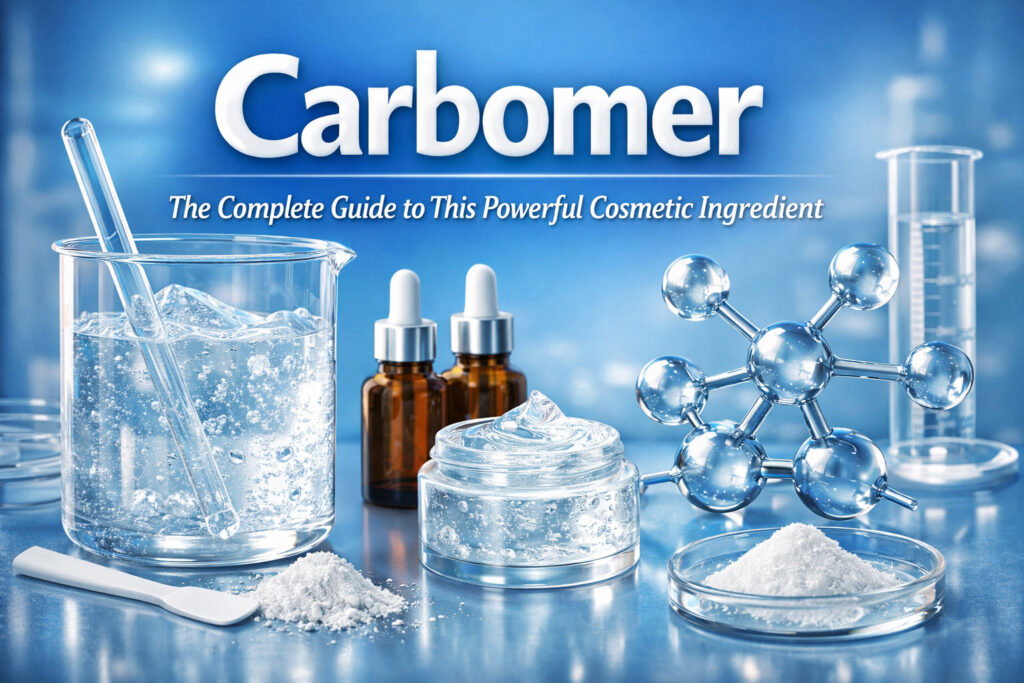
Carbomer: The Complete Guide to This Powerful Cosmetic Ingredient
Carbomer is one of the most widely used ingredients in modern skincare, cosmetics, and pharmaceutical formulations due to its exceptional thickening, gelling, and stabilizing properties. This complete guide to carbomer explains what carbomer is, how it works, and why it plays a crucial role in products like face serums, gels, moisturizers, sunscreens, and medical creams.
Commonly listed as Carbomer on ingredient labels, this synthetic polymer helps create smooth, lightweight, non-greasy textures while improving product stability and performance. It is especially popular in oil-free skincare, hyaluronic acid serums, vitamin C formulations, and niacinamide gels, where clarity and consistency matter most.
In this in-depth guide, you’ll learn about different types of carbomer (Carbomer 940, 980, and 941), recommended usage levels, compatibility with active ingredients, safety for sensitive and acne-prone skin, and whether carbomer is comedogenic or harmful. We also cover common myths, environmental concerns, and how carbomer compares to natural thickeners.
Whether you are a skincare enthusiast, cosmetic formulator, dermatologist, or brand owner, this article provides clear, practical, and science-backed insights into carbomer uses, benefits, safety, and formulation tips—all explained in simple, easy-to-understand language.
Table of Contents
Introduction to Carbomer
If you’ve ever used a face serum that felt silky, a gel that held its shape perfectly, or a sunscreen that didn’t run down your face, chances are carbomer was quietly doing the heavy lifting. It’s one of those behind the scenes ingredients that doesn’t get much hype but without it, modern skincare would be a hot mess.
So, what exactly is carbomer, and why does almost every cosmetic chemist swear by it? Let’s break it down in plain English.
What Is Carbomer?
Carbomer is a synthetic high molecular weight polymer made from acrylic acid. Sounds intimidating, right? Don’t worry it’s basically a super smart ingredient designed to thicken, stabilize, and improve the texture of cosmetic and pharmaceutical products.
Think of carbomer like the scaffolding of a building. You don’t see it, but everything would collapse without it.
Why Carbomer Is So Widely Used
Carbomer is popular because it:
- Works in very small amounts
- Creates crystal-clear gels
- Feels lightweight on skin
- Plays well with many active ingredients
In short, it helps products look good, feel good, and perform better.
The Science Behind Carbomer
Chemical Structure Explained Simply
At a molecular level, carbomer is a long chain of repeating units that love water. When dispersed in water, these chains stay coiled until magic happens.
How Carbomer Swells in Water
Once neutralized, carbomer chains repel each other and expand, trapping water like a sponge. That’s how a watery liquid suddenly turns into a smooth gel.
Role of Neutralization
Carbomer doesn’t thicken on its own. It needs a neutralizer like:
- Triethanolamine (TEA)
- Sodium hydroxide
- Aminomethyl propanol (AMP)
Neutralization = texture transformation. Simple as that.
Types of Carbomer
Carbomer 940
The most popular type. It creates high viscosity, crystal clear gels perfect for face serums and gels.
Carbomer 980
Very similar to 940 but offers better flow and slightly improved sensory feel.
Carbomer 941
Lower viscosity, softer gels. Ideal for lotions and emulsions.
Carbomer vs Acrylates Copolymer
Carbomer gives structure and clarity, while acrylates copolymer focuses more on film forming. Different jobs, same family.
Key Functions of Carbomer in Formulations
Thickening Agent
Carbomer turns runny liquids into luxurious gels with just 0.1–0.5% usage.
Gelling Agent
Want that jelly like bounce in your skincare? Carbomer is your go-to.
Stabilizer and Emulsion Support
It keeps oil and water from separating like a referee keeping peace in a heated match.
Carbomer in Skincare Products
Carbomer in Face Serums
Vitamin C, niacinamide, hyaluronic acid carbomer helps these actives stay evenly distributed while maintaining a lightweight feel.
Carbomer in Gels and Moisturizers
From aloe vera gels to oil free moisturizers, carbomer creates that clean, non sticky texture users love.
Carbomer in Sunscreens and Cleansers
It prevents dripping, improves spreadability, and enhances user experience.
Carbomer in Hair Care Products
Shampoos and Conditioners
Carbomer improves thickness and suspension, ensuring actives don’t sink to the bottom.
Styling Gels and Creams
That hold, glide, and non flaky finish? Yep carbomer again.
Benefits of Carbomer for Skin
Lightweight Texture
No heaviness. No greasy residue. Just smooth application.
Non Greasy Feel
Perfect for oily and acne prone skin types.
Enhanced Product Performance
Better spread = better absorption = better results.
Is Carbomer Safe for Skin?
Dermatological Safety Profile
Carbomer is FDA approved, non toxic, and widely tested.
Is Carbomer Comedogenic?
Nope. Carbomer does not clog pores.
Carbomer for Sensitive Skin
It’s non irritating and suitable for sensitive and reactive skin.
Carbomer and Natural vs Synthetic Debate
Is Carbomer Natural or Synthetic?
Carbomer is synthetic but that’s not a bad thing.
Why Synthetic Doesn’t Mean Harmful
Synthetic ingredients are often more stable, predictable, and safer than poorly preserved natural alternatives.
How Carbomer Is Used in Formulation
Recommended Usage Levels
Typically used at 0.1%–1%, depending on desired thickness.
Common Neutralizers Used
- TEA
- AMP
- NaOH
pH Adjustment Tips
Ideal pH range: 5.5–7.0 for optimal viscosity and skin compatibility.
Carbomer Compatibility with Other Ingredients
Carbomer with Vitamin C
Works best with stabilized forms of Vitamin C.
Carbomer with Hyaluronic Acid
A power duo for hydration and texture.
Carbomer with Niacinamide
Fully compatible and widely used together.
Common Myths About Carbomer
Carbomer Is Plastic Myth or Fact
Myth. It’s a polymer, not microplastic.
Carbomer Clogs Pores Truth Explained
False. It’s non-comedogenic and breathable.
Environmental Impact of Carbomer
Biodegradability Concerns
Carbomer isn’t readily biodegradable, which raises sustainability questions.
Sustainable Alternatives
New bio-based polymers are emerging, but carbomer still outperforms most in stability.
Carbomer in Pharmaceuticals
Medical Gels and Topical Treatments
Used in wound care, pain relief gels, and eye products.
Drug Delivery Applications
Its gel structure helps control release of active drugs.
How to Identify Carbomer on Ingredient Labels
INCI Name Explained
Look for “Carbomer” that’s it. No fancy disguise.
Where It Appears in the List
Usually in the middle or near the end due to low usage levels.
Choosing the Right Carbomer for Your Product
Texture Goals
High viscosity gel? Choose Carbomer 940.
Light lotion? Go for 941.
Stability Requirements
Consider electrolytes, pH, and active ingredients.
Future of Carbomer in Cosmetics
Innovation and Reformulation Trends
Expect hybrid polymers, improved eco profiles, and smarter texture systems.
Conclusion
Carbomer may not be glamorous, but it’s a formulation superhero. From silky serums to crystal clear gels, it makes modern skincare possible. Safe, effective, and incredibly versatile carbomer proves that sometimes the most powerful ingredients are the quiet ones.
FAQs
1. What is carbomer used for in skincare?
Carbomer is used in skincare as a thickening, gelling, and stabilizing agent. It helps create smooth textures in serums, gels, moisturizers, sunscreens, and cleansers while improving product stability.
2. Is carbomer safe for skin?
Yes, carbomer is considered safe for skin. It is FDA-approved, non-toxic, non-irritating, and widely used in cosmetic and pharmaceutical products.
3. Is carbomer comedogenic?
No, carbomer is non-comedogenic. It does not clog pores and is suitable for acne-prone and oily skin types.
4. What is carbomer 940?
Carbomer 940 is a high-viscosity polymer commonly used to create clear, thick gels in skincare and cosmetic formulations such as face serums and aloe vera gels.
5. Is carbomer natural or synthetic?
Carbomer is a synthetic ingredient. Despite being synthetic, it is highly purified, stable, and safe for cosmetic and pharmaceutical use.
6. Can carbomer cause skin irritation?
Carbomer rarely causes skin irritation. It is generally well tolerated, even by sensitive skin, when used within recommended concentrations.
7. Why is carbomer used instead of natural thickeners?
Carbomer is preferred over natural thickeners because it provides better clarity, stability, texture control, and compatibility with active ingredients.
8. Is carbomer the same as microplastic?
No, carbomer is not a microplastic. It is a water-soluble polymer designed for cosmetic and pharmaceutical formulations.
9. Can carbomer be used with vitamin C and hyaluronic acid?
Yes, carbomer works well with hyaluronic acid and stabilized forms of vitamin C, helping maintain uniform texture and performance.
10. Where is carbomer listed on ingredient labels?
Carbomer is usually listed simply as “Carbomer” on ingredient labels and often appears in the middle or lower part of the list due to low usage levels.
Related posts:
 Hyaluronic Acid – The Ultimate Guide to Deep Hydration and Youthful Skin
 Niacinamide – The Ultimate Skincare Ingredient Explained
 Propanediol: The Ultimate Guide to This High-Performance, Skin-Friendly Ingredient
 Kojic Acid: Benefits, Uses, Safety, and How It Transforms Your Skin
 Alpha Arbutin: Complete Guide to Benefits, Uses, Safety, and Skincare Science
 Glycolic Acid – The Complete Guide to Benefits, Uses, Safety, and Skincare Science