

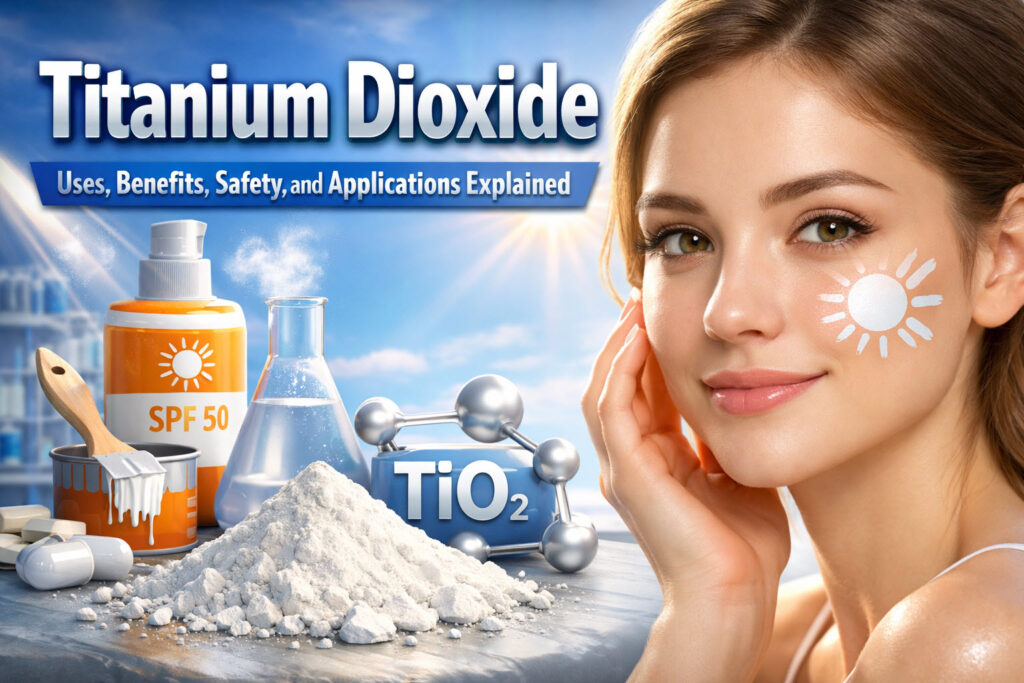
Titanium Dioxide – Uses, Benefits, Safety, and Applications Explained
Titanium Dioxide is one of the most widely used and scientifically trusted ingredients across cosmetics, skincare, sunscreens, pharmaceuticals, food, and industrial applications. Known for its exceptional UV protection, brightening power, and safety profile, Titanium Dioxide plays a vital role in modern product formulations.
In skincare and cosmetics, Titanium Dioxide functions as a physical sunscreen filter, effectively reflecting and scattering harmful UVA and UVB rays away from the skin. Unlike chemical UV filters, it provides instant sun protection, making it ideal for sensitive skin, post-procedure care, and daily sun defense. This is why it is commonly found in mineral sunscreens, BB creams, foundations, pressed powders, and brightening skincare products.
From a formulation perspective, Titanium Dioxide is prized for its high opacity, excellent whitening effect, and formulation stability. It enhances product appearance while maintaining long shelf life. Available in rutile and anatase forms, as well as nano and non-nano grades, it allows formulators to customize texture, coverage, and transparency according to product needs.
Beyond cosmetics, Titanium Dioxide is extensively used in paints and coatings, plastics, pharmaceutical tablet coatings, and food applications due to its brightness, durability, and resistance to UV degradation. Regulatory bodies such as the FDA and EU cosmetic authorities approve Titanium Dioxide for topical use, reinforcing its reputation as a safe and effective ingredient when used correctly.
This detailed guide explores Titanium Dioxide uses, benefits, safety concerns, types, applications, and future trends, helping skincare brands, formulators, and consumers make informed decisions. Whether you are developing a mineral sunscreen, researching cosmetic raw materials, or simply curious about how this powerful ingredient works, Titanium Dioxide remains an essential component in high-performance formulations.
Table of Contents
Introduction to Titanium Dioxide
Ever wondered why your sunscreen looks bright white or why your foundation spreads so smoothly? Chances are, titanium dioxide is doing the heavy lifting behind the scenes. This powerhouse ingredient quietly plays a role in cosmetics, food, medicine, and even construction.
Let’s break it down in simple terms and explore why titanium dioxide is everywhere—and whether it truly deserves its superstar status.
What Is Titanium Dioxide?
Titanium dioxide, often written as TiO₂, is a naturally occurring mineral derived from titanium-bearing ores. In its processed form, it appears as a fine white powder with exceptional brightness and opacity.
Think of it as nature’s own reflector—capable of bouncing light back instead of absorbing it.
Why Titanium Dioxide Matters Today
From sun protection to product aesthetics, titanium dioxide helps brands deliver safer, more effective, and visually appealing products. Its versatility makes it one of the most widely used inorganic compounds in the world.
Chemical and Physical Properties
Chemical Composition of Titanium Dioxide
Titanium dioxide consists of one titanium atom and two oxygen atoms. This simple structure gives it incredible chemical stability, meaning it doesn’t easily react with other ingredients.
Physical Characteristics
Particle Size and Opacity
The smaller the particle, the stronger the coverage. Titanium dioxide’s high refractive index makes it ideal for whitening and concealing imperfections.
UV Light Reflection Ability
Unlike chemical UV filters that absorb sunlight, titanium dioxide reflects and scatters UV rays like a mirror. That’s why it’s a go-to physical sunscreen ingredient.
Types of Titanium Dioxide
Rutile Titanium Dioxide
Rutile is the most stable and commonly used form. It offers excellent UV resistance and is widely preferred in cosmetics and sunscreens.
Anatase Titanium Dioxide
Anatase has higher brightness but lower stability. It’s often used in industrial and catalytic applications.
Nano vs Non-Nano Titanium Dioxide
Nano titanium dioxide offers transparent application on skin, while non-nano provides visible whitening. Both serve different formulation goals.
Manufacturing Process of Titanium Dioxide
Sulfate Process
An older method that uses sulfuric acid. It’s flexible but generates more waste.
Chloride Process
A modern, cleaner process producing high-purity titanium dioxide with less environmental impact.
Environmental Impact of Production
Manufacturers are increasingly adopting eco-friendly methods to reduce emissions and waste.
Uses of Titanium Dioxide
Titanium Dioxide in Cosmetics
Role in Sunscreens
It acts as a physical UV filter, protecting skin from UVA and UVB rays without irritation.
Use in Makeup and Skincare
Foundations, powders, creams, and lotions rely on titanium dioxide for coverage, brightness, and texture.
Titanium Dioxide in Food Industry
Used as a whitening agent (E171) in candies, chewing gum, and baked goods—though its use is regulated in some regions.
Titanium Dioxide in Pharmaceuticals
It coats tablets and capsules, improving appearance and protecting active ingredients from light.
Industrial and Paint Applications
In paints, plastics, and coatings, titanium dioxide provides durability, brightness, and UV resistance.
Benefits of Titanium Dioxide
UV Protection
It shields skin instantly—no waiting time like chemical sunscreens.
Brightening and Whitening Effect
Perfect for cosmetic formulations aiming for a clean, radiant finish.
Stability and Safety Advantages
It doesn’t degrade easily, making products last longer and perform consistently.
Titanium Dioxide in Skincare
How It Protects Skin
It forms a protective layer on the skin surface, reflecting harmful rays away.
Suitable Skin Types
Ideal for sensitive, acne-prone, and post-procedure skin.
Titanium Dioxide for Sensitive Skin
Because it’s non-reactive, it rarely causes irritation or allergies.
Safety and Regulatory Status
Is Titanium Dioxide Safe?
When used topically and in approved forms, titanium dioxide is considered safe by global authorities.
FDA, EU, and Global Regulations
Approved for cosmetics worldwide, though food use restrictions vary by region.
Common Myths and Misconceptions
No, it doesn’t penetrate healthy skin, and no, it’s not toxic when used correctly.
Titanium Dioxide vs Zinc Oxide
Key Differences
Both are physical UV filters, but zinc oxide offers broader UVA protection, while titanium dioxide excels in UVB defense.
Which One Is Better?
The best sunscreens often use both—for balanced protection.
Environmental and Health Concerns
Inhalation Risks
Powdered forms should not be inhaled during manufacturing—proper handling is essential.
Nano Titanium Dioxide Concerns
Research is ongoing, but current evidence supports safe topical use.
How to Choose the Right Titanium Dioxide
Cosmetic Grade vs Industrial Grade
Always choose cosmetic-grade titanium dioxide for personal care formulations.
Tips for Formulators and Brands
Look for surface-treated variants for better dispersion and stability.
Future of Titanium Dioxide
Innovations and Research
Advanced coatings and hybrid UV filters are shaping the future.
Sustainable Alternatives and Trends
Green production methods and biodegradable coatings are gaining traction.
Conclusion
Titanium dioxide may look like a simple white powder, but it’s a multitasking marvel. From shielding your skin to enhancing product quality, it continues to be an irreplaceable ingredient across industries. When used responsibly, it’s safe, effective, and incredibly reliable—like the unsung hero of modern formulations.
Frequently Asked Questions (FAQs)
1. Is titanium dioxide safe for daily skincare use?
Yes, especially in cosmetic-grade, non-inhalable forms.
2. Does titanium dioxide clog pores?
No, it’s non-comedogenic when properly formulated.
3. Why does sunscreen look white on skin?
That’s titanium dioxide reflecting UV light.
4. Is nano titanium dioxide harmful?
Current studies show it’s safe for topical use.
5. Can titanium dioxide replace chemical sunscreens?
In many cases, yes—especially for sensitive skin.
Related posts:
 Hyaluronic Acid Serum – The Ultimate Guide to Deep Hydration and Youthful Skin
 Hyaluronic Acid Gel Benefits: Deep Hydration, Plump Skin & Daily Skincare Guide
 Vitamin C Serum: The Ultimate Guide to Brighter, Healthier Skin
 Niacinamide Serum – The Ultimate Guide to Brighter, Healthier Skin
 Salicylic Acid Face Wash for Acne Control – Complete Guide
 Night Repair Cream: The Ultimate Guide to Overnight Skin Renewal