

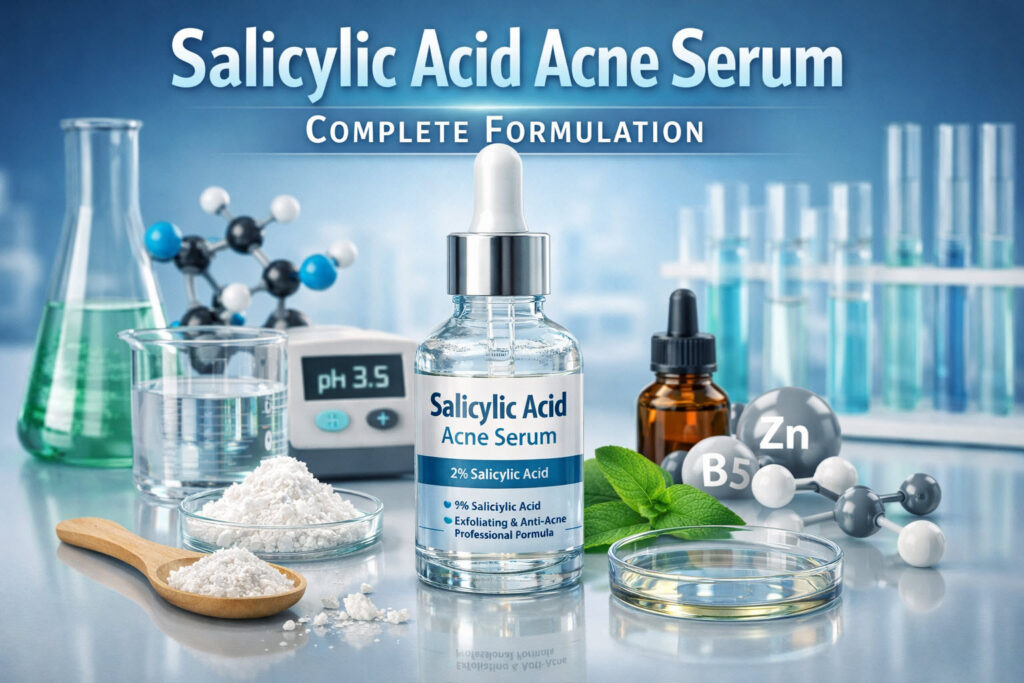
Salicylic Acid Acne Serum Complete Formulation
Salicylic Acid Acne Serum is a scientifically formulated exfoliating treatment designed to target acne, blackheads, whiteheads, and clogged pores at their root. This complete formulation guide explains how salicylic acid (BHA) works by penetrating deep into the pores to dissolve excess oil, exfoliate dead skin cells, and reduce acne-causing bacteria.
In this detailed guide, you will discover the commercial-grade salicylic acid acne serum formulation, including a precise ingredient list with percentages, functional roles of each ingredient, recommended pH range, stability considerations, and a step-by-step manufacturing SOP. The formulation also incorporates skin-soothing and oil-regulating actives such as niacinamide, zinc PCA, panthenol, and allantoin to minimize irritation and improve skin barrier health.
Ideal for cosmetic chemists, private-label skincare brands, formulators, and entrepreneurs, this guide provides industry-ready insights for developing a safe, effective, and market-compliant 2% salicylic acid acne serum suitable for oily and acne-prone skin types.
Table of Contents
1. Product Description
Salicylic Acid Acne Serum is a lightweight, fast-absorbing exfoliating serum formulated to target acne, blackheads, whiteheads, and clogged pores. It uses oil-soluble Salicylic Acid (BHA) to penetrate deep into pores, dissolve excess sebum, and exfoliate dead skin cells, helping to prevent breakouts while improving skin texture and clarity.
This serum is ideal for oily, acne-prone, and combination skin and can be positioned as a daily or alternate-day treatment serum for acne control and pore refinement.
2. Uses of Salicylic Acid Acne Serum
- Treats active acne and breakouts
- Clears clogged pores and blackheads
- Controls excess oil (sebum regulation)
- Reduces acne-causing bacteria
- Smoothens rough skin texture
- Helps fade post-acne marks over time
- Prevents future breakouts
3. Key Benefits
- Deep pore cleansing (BHA technology)
- Reduces inflammation and redness
- Controls oil without over-drying
- Improves skin clarity and texture
- Non-comedogenic & lightweight
- Dermatologically suitable for acne-prone skin
4. Commercial Strength & Safety Level
- Salicylic Acid concentration: 2.0% (Maximum cosmetic limit for leave-on products in many regions)
- pH range: 3.2 – 3.8 (Critical for efficacy & safety)
- Texture: Lightweight gel-serum
- Application: Leave-on serum
5. Commercial Formulation (1000 g Batch)
A. Ingredient Breakdown Table
| Phase | Ingredient | % | Weight (g) | Function |
|---|---|---|---|---|
| A | Purified / Deionized Water | 71.30% | 713 g | Base solvent |
| A | Propanediol (or Butylene Glycol) | 5.00% | 50 g | Solvent, penetration enhancer |
| A | Glycerin | 4.00% | 40 g | Humectant |
| A | Xanthan Gum (Pre-dispersed) | 0.40% | 4 g | Gel former |
| B | Salicylic Acid | 2.00% | 20 g | Acne-treating BHA |
| B | Ethoxydiglycol | 5.00% | 50 g | Salicylic acid solvent |
| C | Niacinamide | 4.00% | 40 g | Oil control, barrier repair |
| C | Panthenol (Vitamin B5) | 1.00% | 10 g | Soothing, healing |
| C | Zinc PCA | 0.50% | 5 g | Sebum regulation, anti-acne |
| C | Allantoin | 0.30% | 3 g | Skin soothing |
| D | Phenoxyethanol & Ethylhexylglycerin | 1.00% | 10 g | Preservative |
| E | Sodium Hydroxide (10% sol.) | q.s | q.s | pH adjustment |
| Total | 100% | 1000 g |
6. Ingredient Functions (Detailed Explanation)
Salicylic Acid (2.0%)
- Oil-soluble beta hydroxy acid
- Penetrates pores to dissolve sebum
- Exfoliates dead skin cells
- Reduces acne inflammation
Ethoxydiglycol
- Essential solvent for Salicylic Acid
- Improves penetration and clarity
- Prevents crystallization
Niacinamide
- Controls oil production
- Strengthens skin barrier
- Reduces redness and post-acne marks
Zinc PCA
- Antibacterial activity
- Reduces shine and acne severity
Panthenol & Allantoin
- Counteract irritation
- Improve skin comfort and healing
7. Manufacturing SOP (Standard Operating Procedure)
Step-by-Step Production Process
STEP 1: Preparation & Hygiene
- Clean and sanitize all equipment
- Wear gloves, mask, hair cover
- Use stainless steel or food-grade containers
- Ensure accurate weighing scales
STEP 2: Phase A – Water Gel Base
- Add Purified Water to main mixing vessel
- Begin slow stirring (300–500 RPM)
- Premix Glycerin + Xanthan Gum to avoid lumps
- Add slowly to water under continuous stirring
- Add Propanediol
- Mix until a smooth, lump-free gel forms
STEP 3: Phase B – Salicylic Acid Solution
- In a separate beaker, add Ethoxydiglycol
- Slowly add Salicylic Acid
- Heat gently to 40–45°C if needed
- Stir until completely dissolved and clear
STEP 4: Combine Phase B into Phase A
- Slowly add Salicylic Acid solution into gel base
- Mix gently to avoid air entrapment
- Ensure uniform distribution
STEP 5: Phase C – Actives Addition
- Add Niacinamide (pre-dissolved in small water)
- Add Panthenol
- Add Zinc PCA
- Add Allantoin (pre-dissolved if needed)
- Mix until homogeneous
STEP 6: Preservation
- Add Phenoxyethanol & Ethylhexylglycerin
- Mix for 10 minutes
STEP 7: pH Adjustment (Critical Step)
- Measure pH (Target: 3.2 – 3.8)
- Adjust slowly using 10% Sodium Hydroxide solution
- Mix and recheck pH after 5 minutes
STEP 8: Final Homogenization
- Mix at low speed for 15–20 minutes
- Remove air bubbles if required
- Check appearance, viscosity, pH
STEP 9: Filling & Packaging
- Fill into airless pump or glass dropper bottles
- Recommended packaging: Amber / UV-protected
- Label with batch number & manufacturing date
8. Quality Control Parameters
| Parameter | Specification |
|---|---|
| Appearance | Clear to slightly hazy gel |
| pH | 3.2 – 3.8 |
| Odor | Mild, neutral |
| Viscosity | Medium gel |
| Stability | 3 months accelerated |
9. Usage Instructions (For Labeling)
- Apply 2–3 drops on clean, dry skin
- Use at night or once daily
- Always apply sunscreen during daytime
- Avoid eye area
10. Regulatory & Safety Notes
- For cosmetic use only
- Patch test recommended
- Not suitable for broken skin
- Avoid combining with strong exfoliants
Related posts:
 Salicylic Acid Acne Serum: The Ultimate Solution for Clear, Blemish-Free Skin
 Day Cream with SPF (Broad Spectrum Protection)
 Night Repair Cream – Advanced Overnight Skin Renewal Formula
 Alpha Arbutin Brightening Serum Complete Commercial Formulation & Manufacturing Guide
 Alpha Arbutin 2% Brightening Gel – Commercial Formulation Guide
 Salicylic Acid 2% Gel for Acne, Blackheads & Oily Skin Complete Formulation Guide