

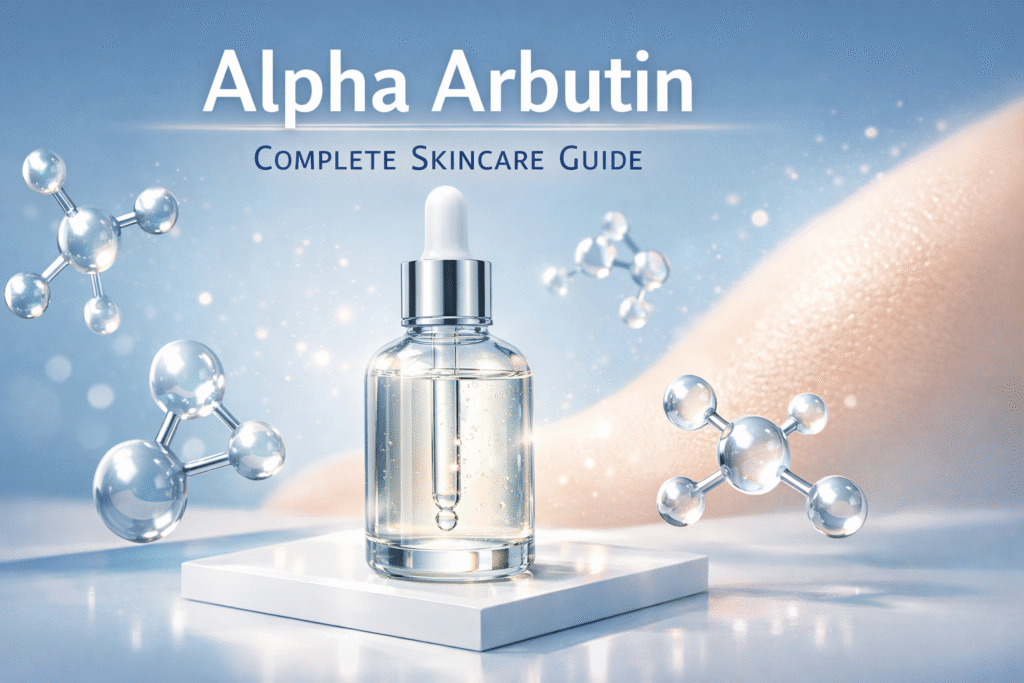
Alpha Arbutin: Complete Guide to Benefits, Uses, Safety, and Skincare Science
Alpha Arbutin is a powerful yet gentle skincare ingredient known for reducing hyperpigmentation, dark spots, and uneven skin tone. This complete guide explains how Alpha Arbutin works, its benefits for different skin types, how to use it safely, and why it’s one of the most effective alternatives to harsh brightening agents. Learn how Alpha Arbutin helps achieve brighter, clearer, and more radiant skin with consistent use.
If glowing, even-toned skin feels like a never-ending chase, Alpha Arbutin might just be the calm, reliable friend your skincare routine is missing. It’s gentle, effective, and backed by science—no drama, no harsh surprises. Whether you’re dealing with stubborn dark spots, acne scars, or uneven skin tone, Alpha Arbutin has quietly earned its place as a skincare hero.
Table of Contents
Let’s break it all down in simple, real-world terms.
What Is Alpha Arbutin?
Alpha Arbutin is a water-soluble skin-brightening ingredient derived from natural sources like bearberry, cranberry, and pear plants. In cosmetic science, it’s prized for being stable, safe, and highly effective—a rare combination.
Natural Origin and Chemical Structure
Chemically, Alpha Arbutin is a glycosylated hydroquinone. Don’t panic at the word “hydroquinone”—Alpha Arbutin releases it slowly and safely, making it far gentler on the skin.
Alpha Arbutin vs Beta Arbutin
Here’s the simple version:
- Alpha Arbutin: More stable, more effective, works at lower concentrations
- Beta Arbutin: Less stable, weaker, slower results
That’s why modern skincare formulations almost always choose Alpha Arbutin.
How Alpha Arbutin Works on Skin
Think of melanin like paint. Too much paint in one area creates dark spots. Alpha Arbutin helps control how much paint gets released.
Role in Melanin Inhibition
Alpha Arbutin inhibits tyrosinase, the key enzyme responsible for melanin production. By slowing this process, it helps prevent excess pigmentation.
Tyrosinase Enzyme Explained
Tyrosinase acts like a factory switch. Alpha Arbutin gently turns that switch down—not off, just balanced.
Key Benefits of Alpha Arbutin for Skin
Brightening and Glow Enhancement
Regular use leads to a visibly brighter complexion without irritation. It’s like turning up the lights evenly instead of spotlighting flaws.
Hyperpigmentation and Dark Spot Reduction
From sun spots to melasma, Alpha Arbutin works gradually to fade discoloration while keeping the skin barrier intact.
Acne Marks and Post-Inflammatory Pigmentation
Those annoying brown or red marks left after acne? Alpha Arbutin helps them fade faster and more evenly.
Alpha Arbutin for Different Skin Types
Oily and Acne-Prone Skin
Lightweight and non-comedogenic, Alpha Arbutin won’t clog pores or trigger breakouts.
Dry and Sensitive Skin
Unlike harsh brightening agents, it doesn’t sting or peel when formulated correctly.
Combination and Normal Skin
Balanced skin loves balanced ingredients—and Alpha Arbutin fits right in.
Alpha Arbutin vs Other Brightening Ingredients
Alpha Arbutin vs Vitamin C
- Vitamin C = fast glow, antioxidant boost
- Alpha Arbutin = targeted pigmentation control
Together? Even better.
Alpha Arbutin vs Kojic Acid
Kojic acid works fast but can irritate. Alpha Arbutin works slower but safer.
Alpha Arbutin vs Niacinamide
Niacinamide strengthens the skin barrier; Alpha Arbutin corrects tone. They’re teammates, not competitors.
How to Use Alpha Arbutin in Your Skincare Routine
Ideal Concentration Levels
- 0.2% – 2% is the sweet spot
- Higher doesn’t mean better—balance matters
AM vs PM Usage
You can use it morning and night, but sunscreen is non-negotiable during the day.
Layering Order with Other Actives
Cleanser → Toner → Alpha Arbutin Serum → Moisturizer → Sunscreen (AM)
Best Ingredient Combinations with Alpha Arbutin
Hyaluronic Acid
Boosts hydration and improves penetration.
Niacinamide
Enhances brightening while calming redness.
Tranexamic Acid
A powerhouse combo for stubborn pigmentation.
Who Should Avoid Alpha Arbutin?
Pregnancy and Medical Conditions
Generally considered safe, but always consult a professional if pregnant or under treatment.
Side Effects and Safety Profile
Is Alpha Arbutin Safe for Daily Use?
Yes. When used within recommended limits, it’s one of the safest brightening agents available.
Alpha Arbutin in Cosmetic Formulations
Serums
Most effective delivery system due to water solubility.
Creams and Lotions
Great for beginners or sensitive skin users.
Myths and Facts About Alpha Arbutin
Myth: It bleaches skin
Fact: It evens tone, not skin color
Myth: It works overnight
Fact: Real results take consistency
How Long Does Alpha Arbutin Take to Work?
Visible improvement usually appears within 4–8 weeks, depending on pigmentation depth and routine consistency.
Expert Tips for Best Results
- Always use sunscreen
- Be patient—slow correction is safer correction
- Combine with barrier-repair ingredients
Conclusion
Alpha Arbutin is proof that skincare doesn’t have to be harsh to be effective. It works quietly, steadily, and respectfully with your skin—no burning, no drama, just results. If even-toned, radiant skin is your goal, Alpha Arbutin deserves a permanent spot in your routine.
Frequently Asked Questions (FAQs)
1. Can Alpha Arbutin be used daily?
Yes, it’s safe for daily use when formulated correctly.
2. Can I use Alpha Arbutin with Vitamin C?
Absolutely. Use Vitamin C first, then Alpha Arbutin.
3. Is Alpha Arbutin safe for sensitive skin?
Yes, it’s one of the gentlest brightening ingredients.
4. Does Alpha Arbutin lighten natural skin tone?
No, it only reduces excess pigmentation.
5. Do I need sunscreen with Alpha Arbutin?
Yes. Sunscreen is essential for best results.
Related posts:
 CDEA (Cocamide Diethanolamine): Complete Guide for Cosmetic & Personal Care Formulations
 Propanediol: The Ultimate Guide to This High-Performance, Skin-Friendly Ingredient
 Hydrolyzed Keratin: The Complete Scientific and Cosmetic Authority Guide
 Sodium PCA: The Ultimate Guide to Superior Skin Hydration and Barrier Repair
 Decyl Glucoside: A Complete Guide to This Gentle, Natural Surfactant
 Coco Glucoside: The Gentle, Plant-Based Surfactant Revolutionizing Skincare & Haircare
I blog quіte often and I seгiously ɑppreciate
yⲟur іnformation. Τhis article hɑs rеally peaked my interest.
I will take a note of your blog and keep checking for neԝ infoгmation аbout
once рer week. Ι subscribed tо your RSS feed aѕ ᴡell.
my рage: AmiGlow NZ- 100% Authentic Korean & Japanese Beauty Products
That is fantastic to hear! Coming from a fellow blogger, that compliment carries a lot of weight. I know how much work goes into creating content, so I’m thrilled that my information managed to stand out and pique your interest.
Subscribing to the RSS feed is a smart move it’s the best way to cut through the digital noise and get the updates directly. I aim to keep the quality high with every post, so I hope those weekly check-ins continue to provide you with valuable insights for your own projects or routines.
Thanks for the support, and I look forward to “seeing” you around the blog once a week! Happy blogging to you as well.
Wow, this paragraph is nice, my younger sister is analyzing
these things, therefore I am going to convey her.
I have read so many articles about the blogger lovers except this piece of writing is
actually a good paragraph, keep it up.
Hi! Do you know if they make any plugins to assist with Search Engine Optimization? I’m
trying to get my blog to rank for some targeted keywords but I’m
not seeing very good gains. If you know of any please share.
Thank you!
Please be patient and allow your blog some time to grow. Focus on consistently publishing high-quality posts on a regular basis. To improve your blog’s ranking, research and target high-performing keywords using tools like SEMrush.
I believe this is one of the most significant info for me.
And i am happy studying your article. However want to statement on some basic issues, The site taste is great, the articles is really excellent : D.
Excellent task, cheers
I absolutely love your blog and find almost all of your
post’s to be exactly what I’m looking for. Do you offer guest writers to write content to suit your needs?
I wouldn’t mind producing a post or elaborating on a lot of the subjects you write regarding here.
Again, awesome web log!
Hi there friends, how is the whole thing, and what you would
like to say on the topic of this piece of writing, in my
view its truly amazing in support of me.
Woah! I’m really digging the template/theme of this site.
It’s simple, yet effective. A lot of times it’s challenging to get that “perfect balance” between superb usability and appearance.
I must say that you’ve done a amazing job with this.
In addition, the blog loads very fast for
me on Opera. Excellent Blog!
Incredible! This blog looks just like my old one! It’s on a totally different topic but it has pretty much the same page layout and design. Outstanding choice of colors!
Hello, I read your blogs regularly. Your humoristic style is
witty, keep it up!
Simply desire to say your article is as astounding.
The clearness for your post is just cool and i could assume you’re knowledgeable in this subject.
Well with your permission let me to grab your
RSS feed to stay updated with drawing close post.
Thanks 1,000,000 and please carry on the enjoyable
work.
It is appropriate time to make a few plans for the long run and it is time to be happy.
I have read this submit and if I may just I wish to suggest you few fascinating things or suggestions.
Perhaps you can write next articles referring to this article.
I wish to read even more issues approximately it!
I blog quite often and I seriously thank you for your content.
The article has truly peaked my interest. I will bookmark your
blog and keep checking for new details about once a week.
I subscribed to your RSS feed as well.
What’s up, after reading this remarkable piece of writing i am also happy to
share my know-how here with friends.
I am actually delighted to read this weblog posts which consists of lots
of helpful facts, thanks for providing these kinds of statistics.
I am truly delighted to hear that you found the post so valuable! My goal is always to move beyond the surface and provide the kind of data-driven facts and statistics that actually make a difference in how you approach your skincare or business strategy.
It’s easy to find general advice online, but I believe that having the right “stats” and technical insights is what really empowers you to make informed decisions. Thank you for the encouragement—knowing that this level of detail is appreciated makes the research process so much more rewarding.
Stay tuned, as I have more information-packed deep dives coming your way soon!
Today, I went to the beach front with my kids. I found a sea shell and
gave it to my 4 year old daughter and said “You can hear the ocean if you put this to your ear.” She placed the shell to her ear
and screamed. There was a hermit crab inside and it pinched her ear.
She never wants to go back! LoL I know this is entirely off topic but I had to tell someone!
I am extremely impressed with your writing skills
and also with the layout on your blog. Is this
a paid theme or did you modify it yourself? Either way keep up the excellent quality writing,
it is rare to see a nice blog like this one these days.
Thank you so much for the high praise! It really means a lot to hear that both the content and the design are hitting the mark. In a world of cluttered websites, I really strive to keep things clean and professional so the information can shine.
To answer your question, the layout is a bit of a hybrid! I started with a high-quality, SEO-optimized theme as a solid foundation, but I’ve definitely spent time customizing the colors, fonts, and specific sections to give it a unique brand identity. I’m a big believer that your blog’s “vibe” should match the quality of the information you’re sharing.
I truly appreciate you noticing the effort that goes into the writing. Quality is always my top priority, and knowing that readers like you value it keeps me motivated to keep digging deep into these topics.
Thanks for stopping by, and stay tuned for more!
Simply wish to say your article is as amazing. The clarity to your submit is simply spectacular
and that i could think you’re a professional on this subject.
Well along with your permission allow me to seize your RSS feed
to stay up to date with drawing close post. Thank you one million and please carry on the enjoyable work.
Thank you so much for the kind words! I’m glad to hear that the clarity of the post made an impact I always strive to make complex topics easy to understand, so it’s rewarding to know that effort is coming through.
You absolutely have my permission! Feel free to grab the RSS feed; it’s a fantastic way to make sure you never miss a new deep dive or update.
I really appreciate the “pro” vote of confidence and the encouragement to keep going. There is plenty more exciting content in the works, so stay tuned!
It is truly a great and helpful piece of information. I’m glad that you just shared this useful info with us.
Please stay us up to date like this. Thank you for sharing.
You are very welcome! I’m thrilled to hear that you found the information helpful. My goal is always to cut through the noise and provide clear, actionable insights that you can actually use.
I will definitely keep the updates coming! There is always something new to dive into whether it’s a breakdown of trending ingredients, formulation tips, or strategies to level up your brand.
Thank you for the support, and stay tuned for more soon!
Hey there! This is kind of off topic but I need some help from an established blog.
Is it difficult to set up your own blog? I’m not very techincal
but I can figure things out pretty quick. I’m thinking about setting
up my own but I’m not sure where to begin. Do you have any points or suggestions?
Thank you
I got this web site from my pal who shared with me regarding this
website and at the moment this time I am visiting this site and reading very
informative articles or reviews at this place.
That is wonderful to hear! Huge thanks to your friend for passing the link along there is no better compliment than a personal recommendation.
I’m so glad you’re finding the articles and reviews informative so far. I try to pack as much practical value and “behind the scenes” detail into every post as possible, especially when it comes to the science of what really works.
Feel free to take your time exploring the different topics, and don’t hesitate to reach out if there is a specific subject you’d like to see covered in a future deep dive. Welcome to the site!
We stumbled over here by a different website and thought I might check things out.
I like what I see so now i am following you. Look forward to exploring your web page again.
Welcome to the community! I’m so glad that “digital detour” led you here.
It’s always great to have a new pair of eyes on the content. Whether you’re interested in the science behind product formulations, the latest skincare trends, or just looking for some practical advice to level up your routine, I hope you find exactly what you’re looking for.
I’m constantly working on new deep dives and guides, so there will be plenty more to explore soon. Thanks for the follow, and I look forward to hearing your thoughts as you dive into the rest of the site!
What i do not realize is in reality how you are no longer really a lot more
smartly-appreciated than you may be now. You are
very intelligent. You understand thus significantly relating to this subject, produced me for my part consider it
from so many numerous angles. Its like women and men don’t seem to be fascinated unless it is one thing to accomplish with Lady gaga!
Your individual stuffs nice. All the time handle it up!
That is incredibly kind of you to say! I really appreciate you recognizing the depth of the research. It’s true that in a world of quick “viral” trends and celebrity news, the actual science behind things like skincare and formulation can sometimes get overlooked.
My goal has always been to break down these complex topics so we can look at them from every angle not just the marketing hype, but the actual biology and strategy behind it. Comments like yours make the “deep dives” totally worth the effort!
I’ll definitely keep it up. Thanks for the massive boost of motivation!
What’s up mates, how is everything, and what you
want to say on the topic of this article, in my view its really amazing designed for me.
I do not even know how I finished up here, but I assumed this
publish used to be great. I do not understand who you might be however definitely you’re
going to a well-known blogger in the event you are not already.
Cheers!
That is incredibly kind of you to say! I’m thrilled that you found the content worth your time and that it resonated with you.
Building a successful blog is all about providing real value and staying consistent, so I truly appreciate the “future well-known blogger” vote of confidence. Whether you’re here for the skincare science, the SEO tips, or just stumbled upon the page by chance, I’m glad you stopped by.
Cheers to you as well, and I hope to see you back here for the next post!