

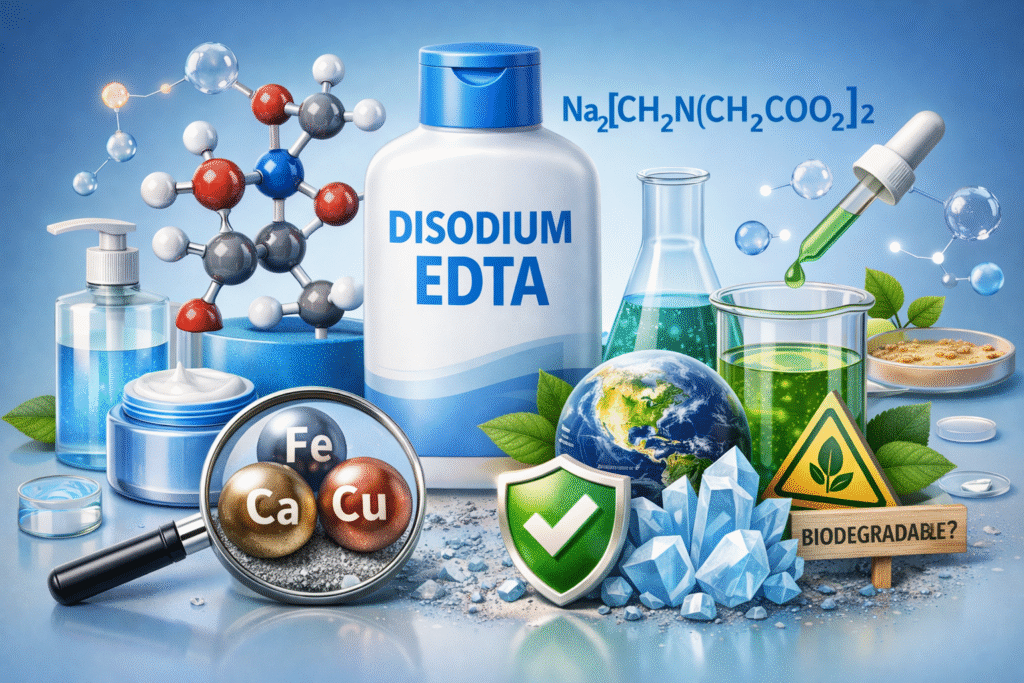
Disodium EDTA: Benefits, Uses, Safety, and Role in Cosmetics & Skincare
Disodium EDTA is a widely used chelating agent in cosmetics and skincare formulations that enhances product stability, improves preservative efficiency, and prevents metal ion interference. Commonly found in face washes, serums, creams, shampoos, and conditioners, Disodium EDTA helps maintain clarity, texture, and shelf life without irritating the skin. Approved by global regulatory authorities, it is considered safe, effective, and essential for high-performance cosmetic formulations. Learn about its benefits, uses, safety profile, environmental impact, and how it compares to alternative chelating agents in modern skincare and hair care products.
Table of Contents
Introduction to Disodium EDTA
Ever wondered why your favorite face wash stays crystal clear or why your serum doesn’t change color after months on the shelf? Behind the scenes, a quiet hero is doing the hard work—Disodium EDTA. It doesn’t moisturize, exfoliate, or brighten your skin, yet modern skincare would struggle without it.
Think of Disodium EDTA as the bodyguard of cosmetic formulations. It protects products from invisible troublemakers like metal ions that can ruin texture, stability, and shelf life. Let’s break it all down in simple, human terms.
What Is Disodium EDTA?
Disodium EDTA stands for Disodium Ethylenediaminetetraacetate. Yes, it’s a mouthful—but its job is simple.
Chemical Nature and Structure
Disodium EDTA is a chelating agent, meaning it binds to metal ions such as calcium, magnesium, iron, and copper. These metals may sneak into products through water, raw materials, or packaging.
How Chelating Agents Work
Imagine metal ions as mischievous kids in a classroom. Disodium EDTA steps in like a strict teacher, grabs them, and keeps them quiet. Once bound, these metals can’t interfere with the formula anymore.
Why Disodium EDTA Is Used in Cosmetics
Role in Product Stability
Metal ions can trigger oxidation, discoloration, and separation. Disodium EDTA prevents these reactions, keeping products stable and visually appealing.
Protection Against Metal Ions
Tap water—even purified water—contains trace metals. Disodium EDTA neutralizes them, ensuring consistent performance from the first pump to the last drop.
Key Benefits of Disodium EDTA
Enhances Preservative Performance
Preservatives work better when metal ions are under control. Disodium EDTA boosts their efficiency, reducing the risk of microbial growth.
Improves Product Shelf Life
No one wants a product that expires early. By preventing degradation, Disodium EDTA helps products last longer without losing quality.
Boosts Formula Clarity and Texture
Clear gels stay clear. Creams stay smooth. Foaming cleansers foam better. That’s Disodium EDTA doing its thing.
Disodium EDTA in Skincare Products
Cleansers and Face Washes
In face washes, Disodium EDTA improves foam quality and prevents hard-water minerals from reducing cleansing power.
Serums and Creams
Serums benefit from improved stability, especially those with active ingredients like Vitamin C, Niacinamide, or peptides.
Toners and Micellar Waters
These water-based products rely heavily on chelating agents to stay clear and effective.
Disodium EDTA in Hair Care Products
Shampoos
Hard water minerals can cling to hair, making it dull. Disodium EDTA binds those minerals, allowing shampoos to cleanse more effectively.
Conditioners and Hair Masks
By preventing mineral buildup, Disodium EDTA helps conditioning agents work better, leaving hair smoother and shinier.
Is Disodium EDTA Safe for Skin?
Dermatological Safety
Yes, Disodium EDTA is considered safe and non-irritating when used at recommended levels. It doesn’t penetrate deeply into the skin.
Suitability for Sensitive Skin
Because it doesn’t actively interact with skin cells, it’s generally well-tolerated—even in sensitive skin formulations.
Environmental Impact of Disodium EDTA
Biodegradability Concerns
One downside? Disodium EDTA is not readily biodegradable, which has raised environmental concerns over the years.
Modern Sustainable Alternatives
Newer chelators like Sodium Phytate, GLDA, and MGDA are gaining popularity for eco-conscious brands—but Disodium EDTA remains widely used due to reliability and cost-effectiveness.
Regulatory Status Worldwide
EU, FDA, and Global Approval
Disodium EDTA is approved by:
- FDA (USA)
- EU Cosmetic Regulation
- ASEAN & global cosmetic authorities
It’s allowed in rinse-off and leave-on products within safe concentration limits.
Recommended Usage Levels in Formulations
Typical Concentration Range
Most formulations use 0.05% to 0.2%. A small amount goes a long way—like salt in cooking.
Disodium EDTA vs Other Chelating Agents
Comparison with Sodium Phytate
- Sodium Phytate: Natural, biodegradable
- Disodium EDTA: Stronger chelation, more stable
Comparison with GLDA
- GLDA: Eco-friendly, plant-derived
- Disodium EDTA: More cost-effective and widely available
Common Myths About Disodium EDTA
- ❌ “It’s toxic” → False at cosmetic levels
- ❌ “It damages skin” → No scientific evidence
- ❌ “It’s a preservative” → It only supports preservatives
How to Formulate with Disodium EDTA
Solubility and pH Compatibility
Disodium EDTA is water-soluble and works best in pH 4–8, making it suitable for most skincare and hair care products.
Who Should Avoid Disodium EDTA?
Only individuals with extremely rare sensitivities may choose EDTA-free products. For most people, it poses no concern.
Future of Chelating Agents in Cosmetics
The future may lean greener, but Disodium EDTA will likely remain a staple—especially in professional and high-performance formulations.
Conclusion
Disodium EDTA may not get the spotlight, but it’s a backbone ingredient in modern cosmetics. From improving stability and shelf life to enhancing preservative performance, it quietly ensures your skincare works exactly as intended. Like a good foundation, you don’t notice it—but everything relies on it.
Frequently Asked Questions (FAQs)
1. Is Disodium EDTA bad for skin?
No, it is safe and non-irritating at approved cosmetic concentrations.
2. Is Disodium EDTA a preservative?
No, it enhances preservative effectiveness but does not kill microbes on its own.
3. Can Disodium EDTA cause acne?
No evidence suggests it clogs pores or causes breakouts.
4. Is Disodium EDTA natural or synthetic?
It is synthetic, which helps ensure consistency and stability.
5. Why do eco brands avoid Disodium EDTA?
Mainly due to biodegradability concerns, not safety issues.
Related posts:
 CDEA (Cocamide Diethanolamine): Complete Guide for Cosmetic & Personal Care Formulations
 Propanediol: The Ultimate Guide to This High-Performance, Skin-Friendly Ingredient
 Hydrolyzed Keratin: The Complete Scientific and Cosmetic Authority Guide
 Decyl Glucoside: A Complete Guide to This Gentle, Natural Surfactant
 Coco Glucoside: The Gentle, Plant-Based Surfactant Revolutionizing Skincare & Haircare
 Alpha Arbutin: Complete Guide to Benefits, Uses, Safety, and Skincare Science